GLP Research Compounds
A 99% Purity Certificate Does Not Say Which Molecule You Got. Identity Is A Separate Test.
Purity and identity answer two different questions. One tells you how clean the peptide is. The other tells you which peptide it actually is. A certificate can pass the first test and never run the second.
 Visit Catalyst Biolabs →
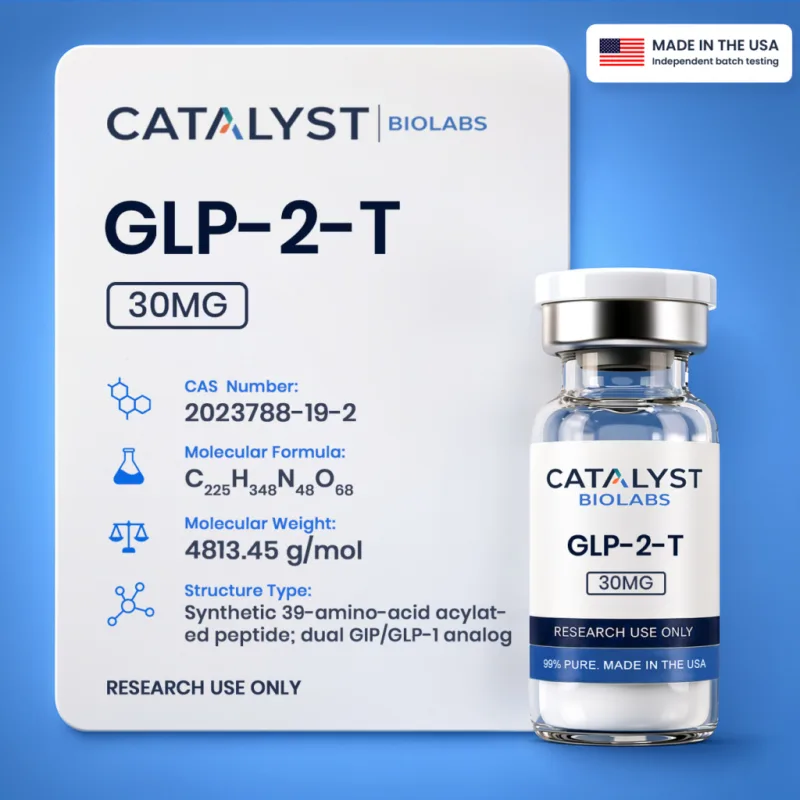
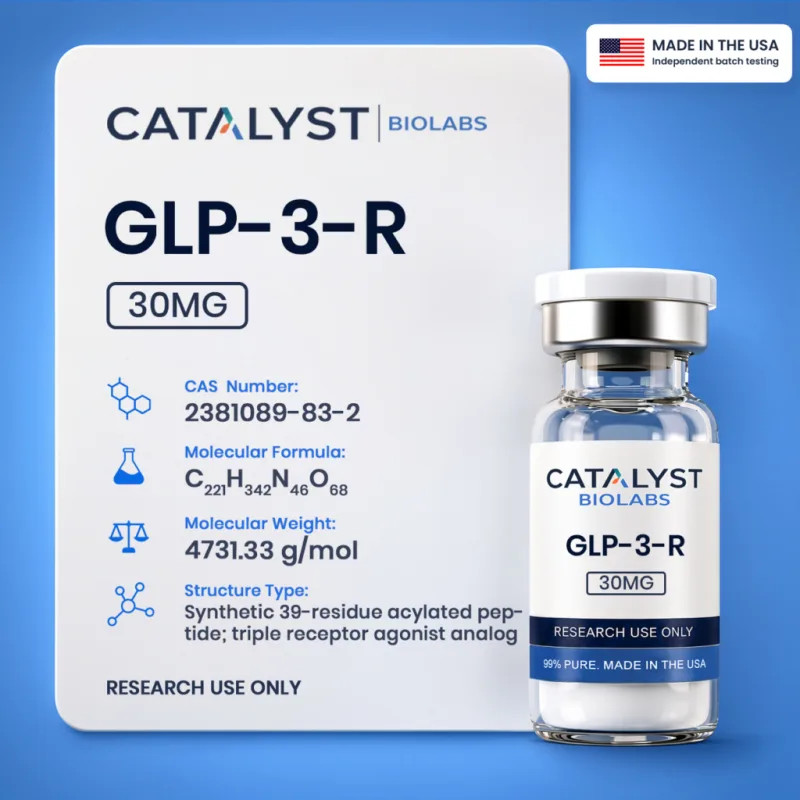
Catalyst's own research catalog currently lists three GLP-class compounds side by side: GLP1-SMA, GLP2-TRZ and GLP3-RTA. Each is a synthetic receptor-agonist peptide, structurally related to the others, sold in similar vials at similar mg strengths.
Ask most suppliers how they know a vial holds the compound on the label, and the answer is a purity percentage. That number is real. It is also answering a different question than the one you asked.
Purity is a ratio. HPLC measures what share of the peptide fraction is a single, uniform compound. It does not know or report which compound that is.
Identity is a separate test. LC-MS (liquid chromatography, mass spectrometry) confirms the molecule itself, by matching its mass against the reference structure for that exact compound.
A vial can return 99% on a purity run without that run ever confirming which of the three GLP compounds is inside it.
Catalyst reports identity and purity on the same certificate.
LC-MS identity confirmation, run alongside HPLC purity, tied to the lot number on the vial.
Visit Catalyst Biolabs →1A percentage cannot name a molecule
Purity testing runs a sample against itself. It answers: of whatever is in this vial, how much of it is one consistent substance? A perfectly uniform vial of the wrong compound can still score high on that test.
Purity says how clean it is. It does not say what it is.
2Why a GLP stack makes this worse, not better
A single-product supplier selling one peptide has less room to mix up a label. A catalog carrying three related GLP-class compounds, produced on shared equipment and packaged in near-identical vials, is exactly the situation where an identity check earns its keep.
None of this is a claim that mislabeling is common. It is a description of why the test exists, and why a category with several similar products is the one where skipping it costs the most.
The more similar the products on a shelf, the more an identity test is actually doing.
3Why identity testing gets skipped
Purity runs off a standard HPLC method most labs already have queued. Identity confirmation by LC-MS is a separate instrument, a separate method, and a separate line item a supplier has to choose to pay for and publish.
A certificate with no identity line is not proof of anything wrong. It is the absence of a specific answer to a specific question.
A missing test is not evidence of a problem. It is the absence of evidence either way.
Sample format, reflecting the fields Catalyst publishes on a Certificate of Analysis. Open a real, lot-specific certificate on Catalyst's own COA library.
 Visit Catalyst Biolabs →
Open a real certificate. Check the identity line yourself.
Every Catalyst lot ships with a Certificate of Analysis you can also verify on the testing lab's own site.
Open Catalyst Biolabs →4How to check it in under a minute
- A line that says identity, or identity confirmation. If it is not there, that test was not run.
- The method named. LC-MS or mass spectrometry, not just "tested."
- The lot number matching your vial. A product-level document proves nothing about the batch in your hand.
- A laboratory name, independent of the seller. Signed by the lab, not the company selling you the vial.
| On the certificate | Catalyst Biolabs | Typical supplier |
|---|---|---|
| Purity figure | HPLC, reported | Reported |
| Identity confirmation | LC-MS, same report | Often absent |
| Testing lab | Independent, named | Sometimes in-house |
| Tied to your exact lot | Published before order | Product-level, reused |
| Lookup you can run yourself | Public verification page | Email and wait |
5What actually arrives
- A vial with a lot number printed on it.
- A certificate carrying that same lot number.
- Six checks on that document, including identity by LC-MS, not just a purity percentage.
- A signature from an accredited, independent U.S. laboratory.
Read the identity line first. Then decide.
Open any GLP listing, read the certificate for that exact lot, and check that identity was actually tested, not assumed.
Visit Catalyst Biolabs →
Comments
Never separated purity from identity in my head before this. Went back through old certificates from another supplier and there was no identity line on any of them.
Same experience. I had been assuming a high purity number meant the product was confirmed. It doesn't.
Ordered GLP2-TRZ and pulled the certificate before it even shipped. Identity, purity and content all on one page, lot number matched the vial.
The three-GLP-compound point is what got me. Easy to see how that could go wrong somewhere with less documentation.
Same-day shipping was accurate for me too, ordered before 3pm and it moved that afternoon.
Checked the COA against the lab's own site directly rather than trusting the PDF. Matched exactly.